The core objective of material chemical engineering is to leverage chemical engineering theories and methodologies to guide material preparation and processing, thereby developing new unit technologies and theories based on advanced materials. Within this field, high-entropy fluorophosphate cathode materials are recognized as strategic assets for large-scale energy storage in sodium-ion batteries (SIBs) due to their remarkable electrochemical activity. However, the large-scale synthesis of these materials with high phase purity remains a significant bottleneck challenge. Traditional batch reactors suffer from low iteration efficiency in optimizing reaction conditions, leading to poor phase purity and inferior rate performance—obstacles that have hindered the practical application of high-entropy fluorophosphates in grid-scale energy storage.
To address these challenges, Professor Xu Jianhong from the Department of Chemical Engineering at Tsinghua University, in collaboration with Professor Wu Xingjiang from the School of Chemical Engineering and Technology at Hebei University of Technology, has proposed a microfluidic high-throughput optimization strategy to facilitate the scalable production of high-phase-purity high-entropy fluorophosphate cathodes. The team developed a specialized microfluidic in-situ Raman spectrometer, enabling high-throughput optimization of reaction conditions by precisely regulating and monitoring the nucleation and growth processes of Na3V1.9(Ca, Mg, Zr, Mn, Cr)0.1(PO4)2F3 in real-time. This approach achieves an iteration efficiency 400 times higher than that of traditional batch reactors. Guided by these high-throughput theoretical insights, the researchers developed a microfluidic spray drying technology, achieving the rapid, kilogram-scale synthesis of high-phase-purity cathode materials. The study further demonstrated the universal applicability of this technology by successfully synthesizing various high-entropy compositions, including Na3V1.9(Mg, Zr, Co, Mn, Cr)0.1(PO4)2F3, Na3V1.9(Zr, Ca, Fe, Mn, Cr)0.1(PO4)2F3, Na3V1.9(Mg, Ca, Ni, Mn, Cr)0.1(PO4)2F3, Na3V1.9(Zr, Cu, Mg, Mn, Cr)0.1(PO4)2F3and Na3V1.9(Ga, Zr, Ca, Mn, Cr)0.1(PO4)2F3,etc.
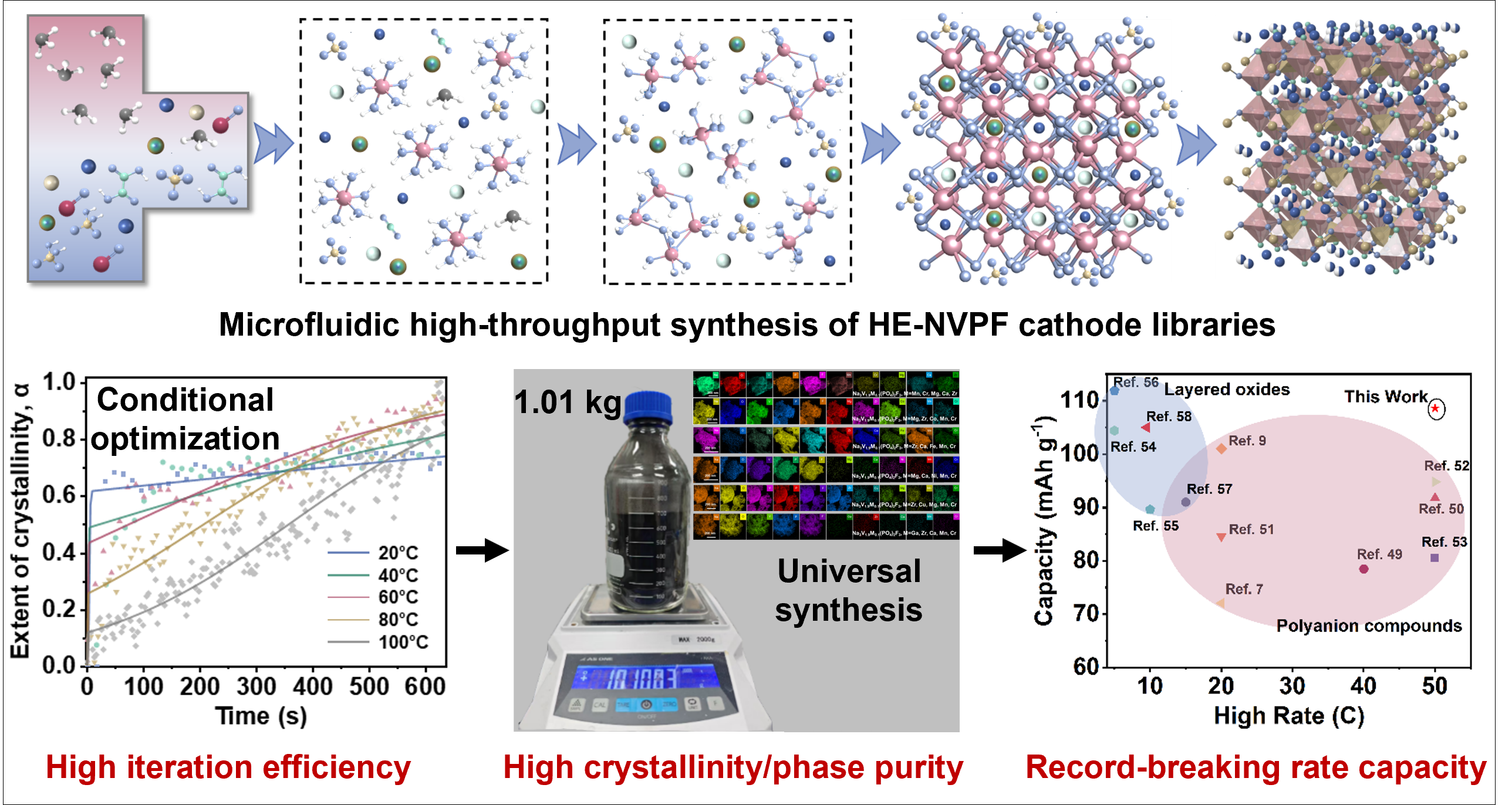
Figure 1. Microfluidic high-throughput optimization guides the continuous-flow synthesis of high-entropy sodium vanadium fluorophosphate, achieving record-high rate performance.
High phase purity ensures that these high-entropy materials possess stable multi-electron transfer capabilities, superior Na+ diffusion kinetics, and robust structural integrity. This allows for reversible phase transitions and negligible volume expansion or contraction during charge-discharge cycles. Using Na3V1.9(Ca, Mg, Zr, Mn, Cr)0.1(PO4)2F3 as a primary example, the material exhibits a high specific capacity of 121.8 mAh/g at 0.5 C, remarkable rate performance of 108.6 mAh/g at an ultra-high rate of 50 C, high energy density of 371.9 Wh/kg and cycling stability of 86% capacity retention after 500 cycles at high current densities. Notably, this rate performance significantly outperforms cathode materials prepared via traditional batch methods, such as transition metal layered oxides, polyanionic compounds, and Prussian blue analogs.
This research provides a transformative theoretical framework and a powerful technical toolkit for the design, rapid screening, and scalable synthesis of high-entropy fluorophosphates and other high-entropy energy materials.
This study, titled "Microfluidic High-Throughput Optimization Enables Scalable Synthesis of High-Entropy Fluorophosphate Cathode" was recently published in the prestigious journal National Science Review. Professor Xu Jianhong (Tsinghua University) and Professor Wu Xingjiang (Hebei University of Technology) serve as the corresponding authors. The lead authors are PhD students Tian Zhicheng and Zhou Yuanzheng from Tsinghua University’s Department of Chemical Engineering.