
Research
Research

Research


Achieving carbon neutrality has become a pressing global challenge, and the rapid emergence of artificial intelligence is revolutionizing how we design materials, processes, and systems. Amid these profound shifts, our department is committed to advancing a new paradigm of chemical engineering that supports global carbon-neutrality goals and sustainable development. Our vision is to integrate fundamental science, advanced technologies, and industrial practice to transform how chemicals, materials, and energy are produced and used.
This vision rests on two strong foundations. The first is the fundamentals of chemical engineering, including thermodynamics, transport phenomena, reaction engineering, separation processes, systems engineering, and safety. These fundamentals provide the rigorous scientific framework with which we analyze, design, and optimize complex chemical processes. The second foundation is the frontiers of artificial intelligence. By embedding data science, machine learning, and intelligent control into research and education, we accelerate materials and process discovery, build high-throughput and autonomous experimentation platforms, and develop intelligent, resilient chemical manufacturing systems.
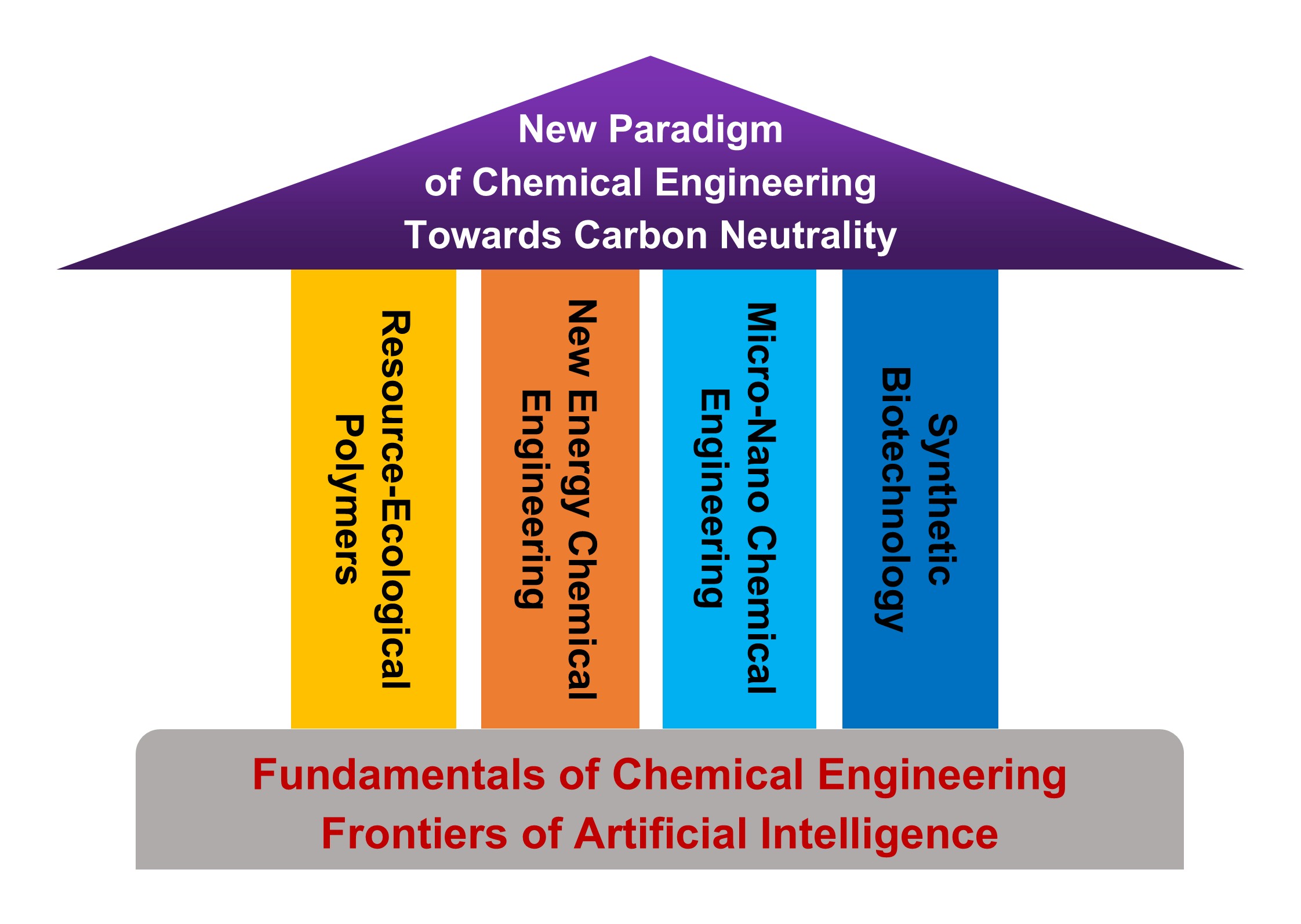
Building on these foundations, our research is organized around four interconnected frontiers that serve as the core pillars of the department:
 Micro-Nano Chemical Engineering
This research direction focuses on micro- and nano-scale transport, reaction processes, and structural design of functional materials, together with intelligent process and system design. Research topics include microreaction and flow chemistry, micro-nano process intensification, advanced porous and nanostructured materials, and their integration into miniaturized, highly efficient reactors and separation units. By coupling micro-nano process technologies with artificial intelligence and process systems engineering, we develop autonomous design, control, and optimization strategies, and explore modular, distributed manufacturing platforms for agile and low-carbon chemical production.
New Energy Chemical Engineering
This research direction targets low-carbon energy systems built on electricity and hydrogen. Key topics include advanced batteries and other energy-storage materials and devices, green electricity-driven chemical processes (for example, electrocatalytic and power-to-chemicals routes), and hydrogen energy technologies covering clean hydrogen production, storage, transport, and utilization. By integrating materials innovation with multiscale process and system design, we aim to create efficient, flexible, and safe new-energy infrastructures.
Synthetic Biotechnology
Building on molecular biology and metabolic engineering, this research direction develops cell factories, enzyme catalysis, and biosynthetic pathways for chemicals, fuels, and materials, supported by AI-driven platforms for strain design, pathway optimization, and bioprocess control. We aim to replace traditional petrochemical routes with bio-based, low-carbon processes and to explore new bio-interfaces with materials and devices for next-generation biochemical engineering.
Resource-Ecological Polymers
This research direction addresses the design, synthesis, processing, and life-cycle management of polymeric materials under the principles of resource efficiency and environmental compatibility. Key topics include CO₂-based and other bio-derived monomers, green and high-performance engineering plastics and fibers, degradable and recyclable polymers, functional films and coatings, Janus polymer materials and interfaces, as well as polymer systems for energy, environmental, and biomedical applications. By integrating molecular design with process engineering and recycling/upcycling technologies, we aim to build closed-loop polymer value chains that support a resource-saving and environmentally friendly society.