Heterogeneous catalysts are central to both the chemical industry and emerging electrochemical energy conversion technologies, and they are essential for advancing low-carbon and sustainable development goals. Conventional catalyst development relies heavily on extensive experimental trial-and-error and costly theoretical calculations, resulting in long development cycles, high costs, and low efficiency. In recent years, an “intelligent R&D” paradigm that integrates artificial intelligence (AI) with high-throughput computation has opened an efficient and practical pathway for rational design and rapid discovery of new catalytic materials from the atomic scale. The research group led by Associate Professor Xiaonan Wang at the Department of Chemical Engineering, Tsinghua University has long been engaged in this interdisciplinary field. Recently, the team has systematically established a multiscale AI predictive framework spanning key stages including catalyst surface design, activity and selectivity screening, and reaction kinetics optimization, thereby providing enabling support for rational catalyst design and intelligent discovery.
First, to address the foundational question of whether a catalytic material surface is stable and synthesizable, the team developed SurFF, a surface-property foundation model. Through an active learning strategy, they built a large-scale database covering over ten thousand alloy surfaces to accurately predict surface energies and equilibrium morphologies (Wulff constructions) of crystalline materials. While maintaining comparable accuracy, SurFF achieves a computational efficiency improvement of more than five orders of magnitude relative to conventional density functional theory (DFT) calculations, and for the first time enables high-throughput screening of synthesizability and surface exposure across thousands of crystalline materials. In addition, the team used large language models to mine large-scale literature data, extracting Miller-index information from XRD/TEM reports in more than 10,000 catalysis papers, and, together with original experimental data, validated the model’s accuracy in real catalytic systems. This work provides a solid foundation for rational catalyst design and next-generation autonomous closed-loop materials R&D. The related results, titled “SurFF: A Foundation Model for Surface Exposure and Morphology Across Intermetallic Crystals,” were published in Nature Computational Science on September 9.
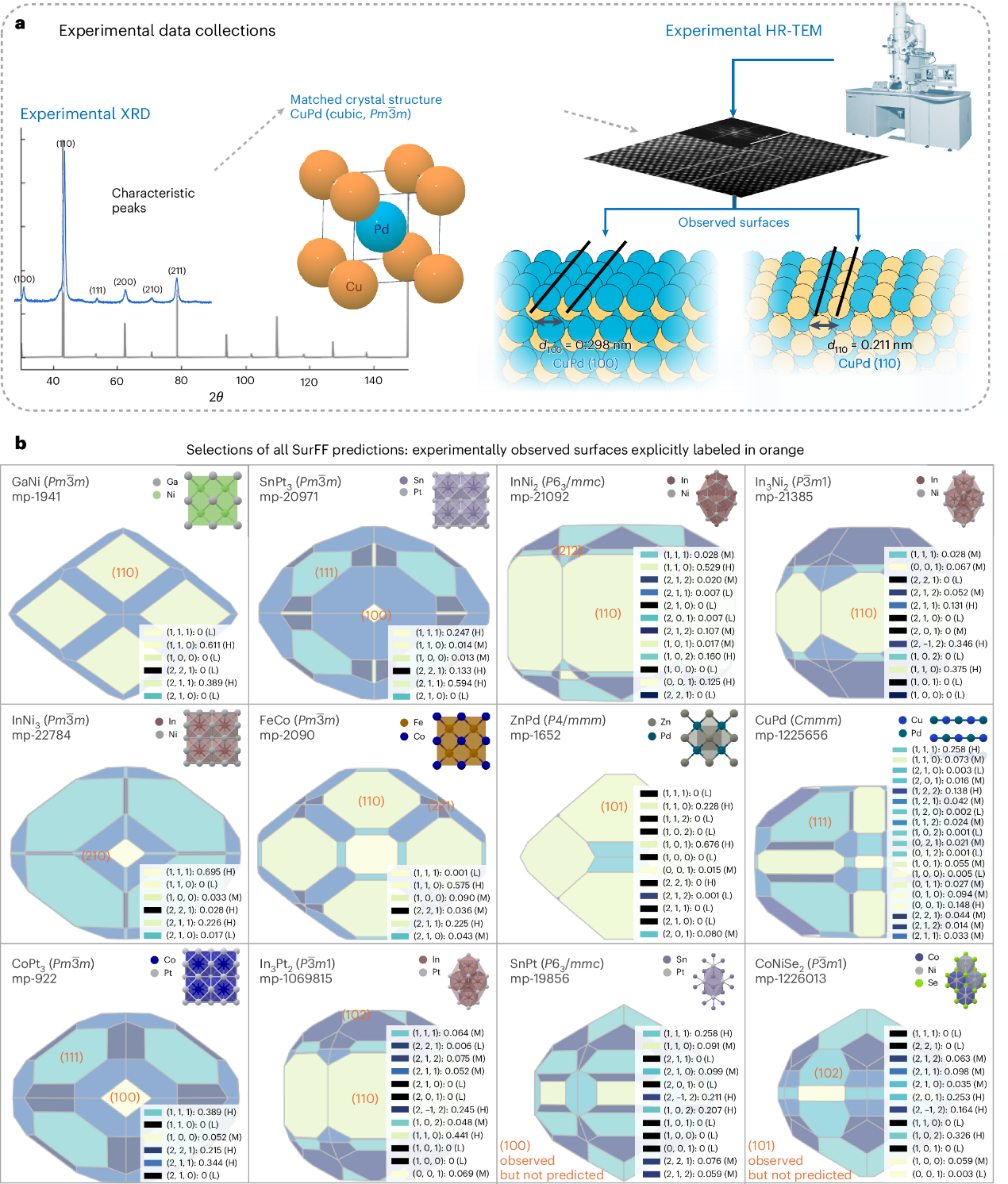
Using the SurFF foundation model to predict experimental-level surface synthesizability and exposure
Second, focusing on the major technological challenge of screening catalysts for activity and selectivity in the electrochemical reduction of carbon dioxide to methanol, the team proposed an AI-driven high-throughput catalyst screening framework. Building on a pretrained atomic foundation model and combined with an active learning strategy, the approach can rapidly fine-tune a high-accuracy predictive model using only a small amount of DFT data. This method improves the screening efficiency for catalyst adsorption properties by more than 1,000-fold and successfully identified a series of new single-atom catalysts whose overall performance surpasses existing benchmarks from a pool of more than 3,000 candidate materials. The related results, titled “Theoretical High-Throughput Screening of Single-Atom CO2 Electroreduction Catalysts to Methanol Using Active Learning,” were published in Engineering on August 5.

Rational catalyst screening integrating active learning with an atomic foundation model
Going further, the team developed an intelligent transition-state screening framework named CaTS, targeting reaction kinetics optimization, widely regarded as the most difficult and time-consuming aspect of catalyst design. Transition-state calculations are critical for predicting reaction rates, yet their high computational cost has long been the key bottleneck limiting large-scale screening. CaTS innovatively adopts a transfer learning strategy: with only a few hundred catalytic reaction data points, it can train a high-accuracy machine-learning force field, improving transition-state search efficiency by nearly 10,000-fold while maintaining high consistency with DFT in both energy and structural predictions. This work was published in ACS Catalysis on August 27, providing a powerful tool for large-scale, high-efficiency catalyst screening from a kinetics perspective.
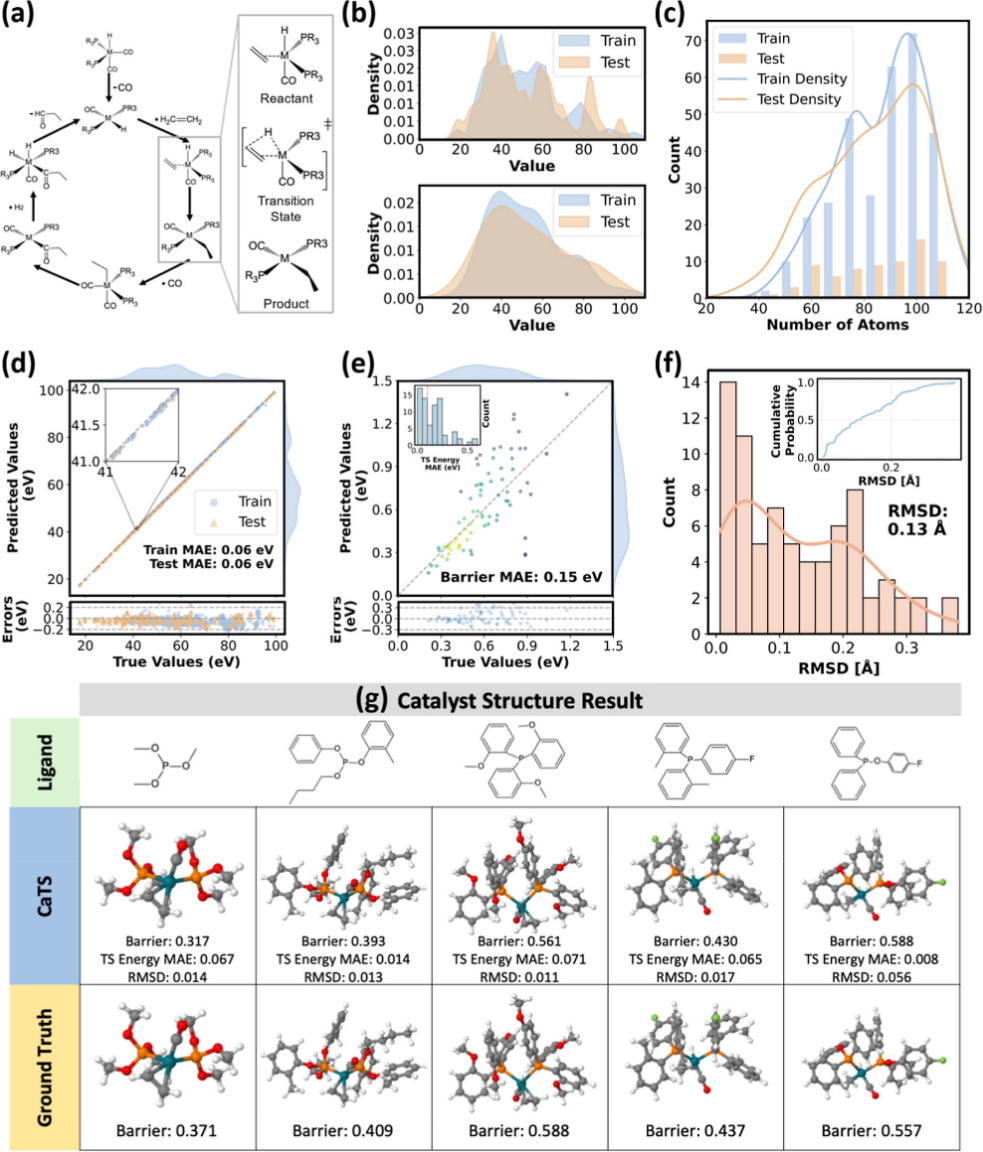
Example of CaTS model transfer and its screening application to a homogeneous hydrogenation catalytic system
Together, these three studies address key scientific questions in rational and intelligent catalyst design, forming a relatively complete AI-driven multiscale catalysis research framework that spans from static structures to dynamic reactions. This framework accelerates the transition of catalyst R&D from traditional trial-and-error approaches toward efficient and precise “intelligent prediction,” and provides theoretical support and new methodological references for the design of a wide range of heterogeneous catalysts.
Associate Professor Xiaonan Wang (Department of Chemical Engineering, Tsinghua University) is the sole corresponding author of this series of work. The first authors include Honghao Chen (PhD student, Class of 2022, Department of Chemical Engineering, Tsinghua University), Wentao Li (PhD student, Class of 2024, Department of Chemical Engineering, Tsinghua University), and Jun Yin (PhD graduate, National University of Singapore). Other collaborators include Professor Tiefeng Wang (Department of Chemical Engineering, Tsinghua University), Assistant Researcher Xiaocheng Lan, and Dr. Huasheng Feng (SINOPEC Beijing Research Institute of Chemical Industry), among others. This research was supported by the National Key R&D Program of China, the Scientific Research Innovation Capability Support Project for Young Faculty from the Ministry of Education (U40), the Tsinghua University Initiative Scientific Research Program, the Carbon Neutrality and Energy System Transformation (CNEST) led by Tsinghua University, the Young Beijing Scholars Program, and related funding sources.
Paper links:
https://www.nature.com/articles/s43588-025-00839-0
https://doi.org/10.1016/j.eng.2025.03.039
https://pubs.acs.org/doi/10.1021/acscatal.5c03945